What Is On-Exchange vs. Off-Exchange Health Insurance?
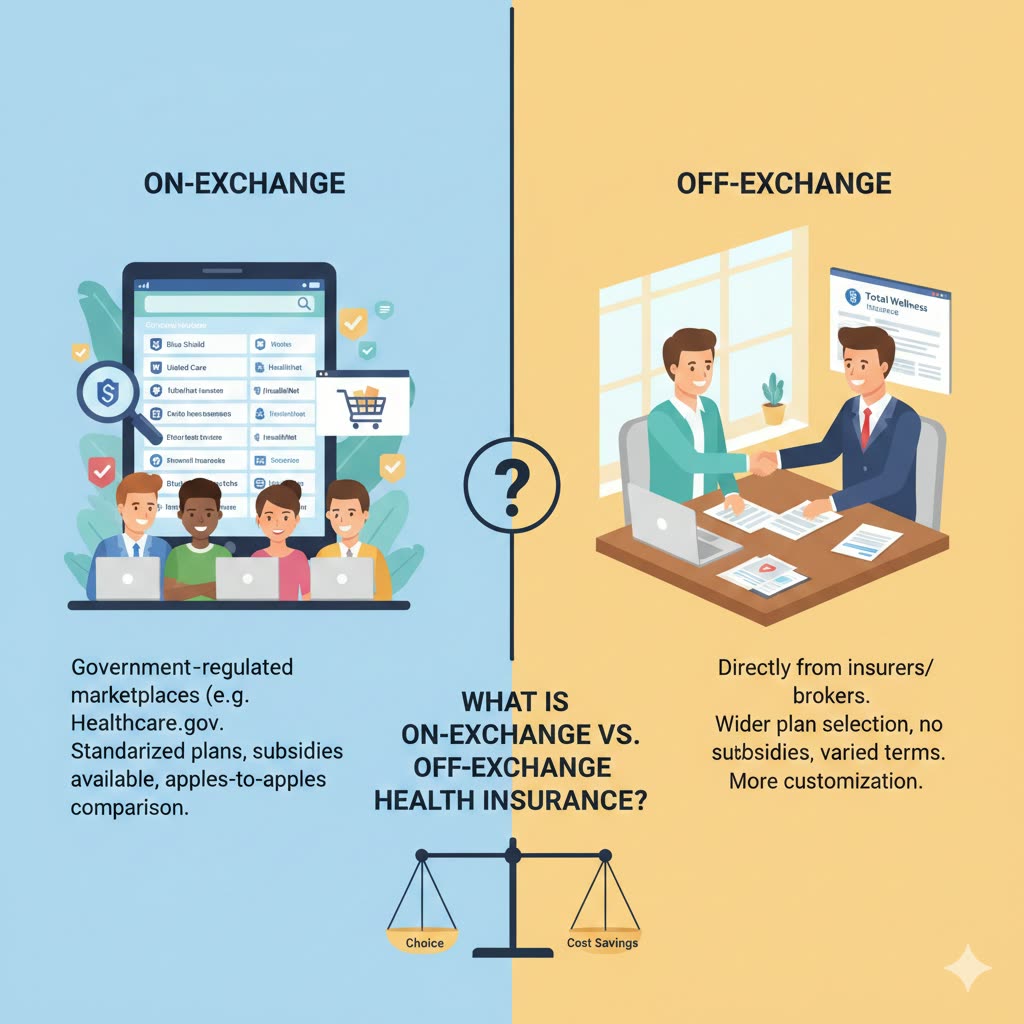

When shopping for health insurance, people often hear the terms On-Exchange and Off-Exchange. Although they may sound similar, they are not interchangeable. Choosing the wrong option can cost you thousands of dollars per year or even leave you without legal access to financial assistance.
Here is what every consumer should know before enrolling.
1. What Is an On-Exchange Plan?
An On-Exchange plan is a health insurance policy offered through the Health Insurance Marketplace (HealthCare.gov or your state’s exchange).
These plans:
- Meet all Affordable Care Act (ACA) requirements.
- Cover essential benefits (hospitalization, prescriptions, maternity, mental health, etc.).
- Are the only plans eligible for Premium Tax Credits (PTC) and Cost-Sharing Reductions (CSR).
- Allow Special Enrollment Periods (SEP) only under specific qualifying events.
In short: If you want financial help from the government to reduce your monthly cost, you MUST enroll in an On-Exchange plan.
2. What Is an Off-Exchange Plan?
Off-Exchange plans are ACA-compliant health insurance policies sold outside the Marketplace, directly from carriers or brokers.
Important facts:
- They can offer the same benefits and networks as On-Exchange plans.
- They do NOT qualify for Premium Tax Credits (zero financial assistance).
- They sometimes have different underwriting rules for eligibility.
- They may offer more plan variations, but often at full, unsubsidized price.
These plans are typically chosen by:
- People whose income is too high for subsidies.
- Individuals with very specific coverage needs.
- Certain immigrants who do not qualify for Marketplace enrollment.
3. What Are the Key Differences?
| Feature | On-Exchange | Off-Exchange |
| Eligibility for Subsidies | Yes | No |
| Enrollment | Through Marketplace | Through carriers/brokers |
| Coverage Rules | ACA-compliant | Usually ACA-compliant |
| Financial Assistance | Available | Not available |
| SEP (mid-year changes) | Strictly regulated | Varies by carrier |
| Pricing | Based on income | Full price |
Bottom line:
If you qualify for financial help, On-Exchange is almost always the smarter choice.
If you do not qualify for subsidies, Off-Exchange may provide additional options.
4. Short-Term Health Plans: What You MUST Know
Short-term plans are not ACA plans. They are temporary medical policies designed for emergency gaps in coverage.
Key limitations:
- They do NOT cover essential health benefits.
- They can exclude pre-existing conditions.
- They can deny your application.
- They do not offer financial assistance.
- They can leave major gaps in protection—hospital bills, maternity, mental health, prescriptions, and follow-up care may all be limited or excluded.
What does the law allow?
Federal rules allow short-term plans only as temporary stopgaps, not long-term comprehensive care.They are not substitutes for real health insurance.
If you rely on a short-term plan instead of enrolling in the ACA Marketplace, you risk:
- Remaining uninsured for major medical needs
- Facing high out-of-pocket costs
- Losing access to 2026 Marketplace enrollment if you miss Open Enrollment
5. Final Warning: Missing Open Enrollment Has Consequences
If you do not enroll On-Exchange during Open Enrollment, the law may block you from getting coverage for the entire year unless you qualify for very limited Special Enrollment exceptions.
Short-term plans will not protect you from this.
Doctor Insurance One Can Help

At Doctor Insurance One, we specialize in evaluating whether On-Exchange or Off-Exchange is best for your situation. We ensure you get the maximum legal assistance, the best coverage, and avoid mistakes that can leave you uninsured all year.
Do not guess. Get expert guidance today. Call us at (800) 305-7709 or schedule online.
Recent posts

We are open later, and on Saturdays, this Open Enrollment
Open Enrollment decides your family's coverage for the whole year, and it arrives when everyone is busiest. So we are answering the phone until 8 pm Miami time on weekdays, and on Saturdays too. Here is when to call from Florida, Texas and the other cities we serve.

Humana and UnitedHealthcare are cancelling Medicare Advantage plans. Here is what to do if yours ends.
Humana and UnitedHealthcare are ending Medicare Advantage plans that cover nearly 1 million people. How to tell if yours is one of them, what happens on January 1 if you do nothing, and the three windows you have to fix it.

Obamacare 2027: what to have ready before enrollment opens November 1
Open Enrollment for 2027 runs November 1 to January 15, and a preview of next year's plans comes first. Use it to bring us your medicines, your doctors, anything planned for 2027 and your income, so you pick the plan that fits, do not overpay, and are not surprised at tax time.