
Why Medicare open enrollment runs from October 15 to December 7
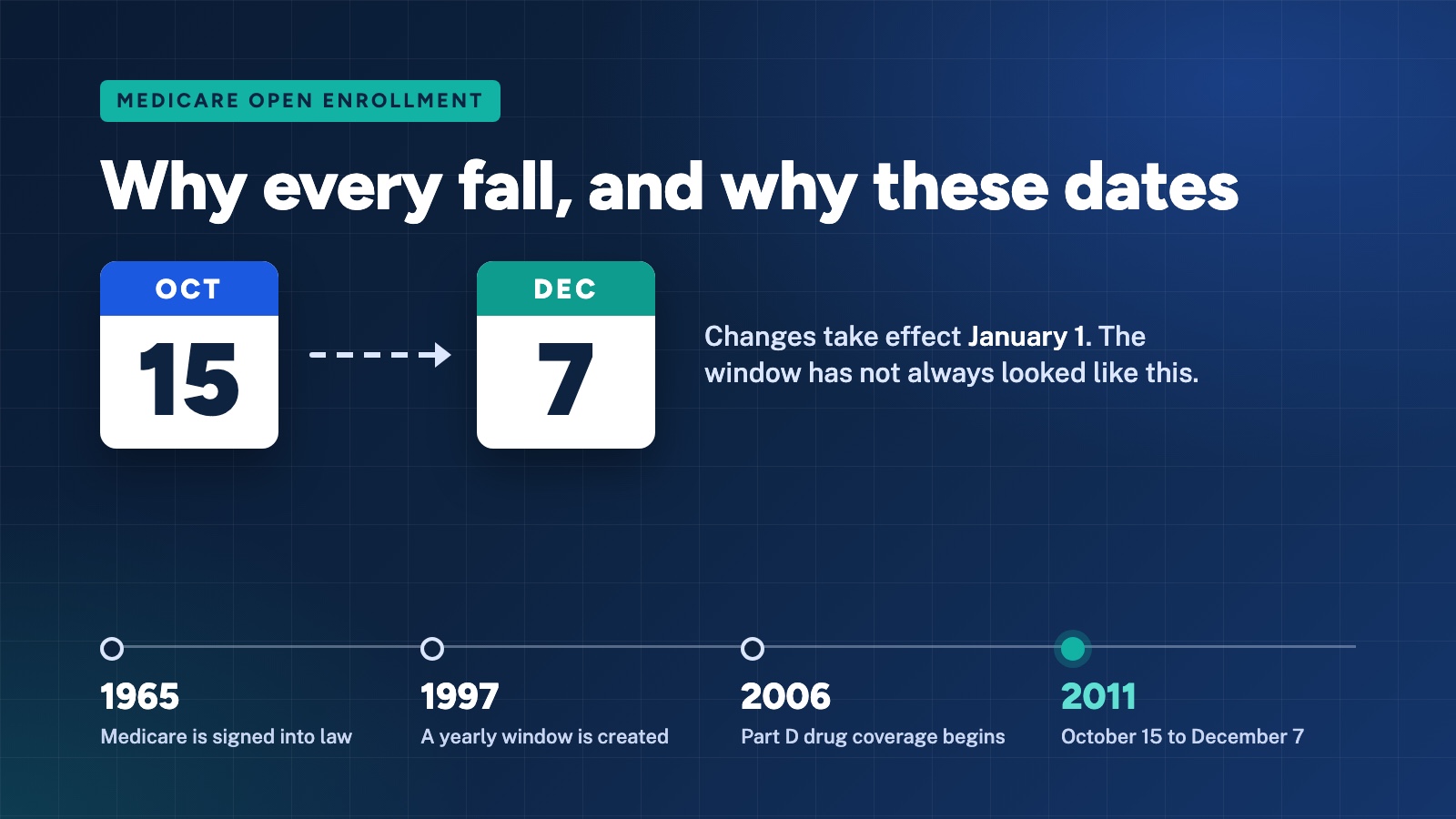
Every year from October 15 to December 7, people with Medicare can change how they get their coverage for the following year. This year it opens on Thursday, October 15, 2026 and closes on Monday, December 7, and any change made in that window takes effect on January 1, 2027. It goes by several names, which is part of why it confuses people. Here is what it is, where it came from, and why it falls on those dates.
One period, three names
Medicare.gov calls it Open Enrollment. The federal law that sets the dates calls it the "annual, coordinated election period," which is where the insurance industry's shorthand, AEP, comes from. You will also hear it called the Annual Enrollment Period. All of them mean the same seven weeks.
It is not the same thing as open enrollment for ACA Marketplace plans, the individual health plans many people under 65 buy. That is a separate program with its own calendar, and a date for one tells you nothing about the other.
What you can do during it
- Switch from Original Medicare to a Medicare Advantage Plan, or from a Medicare Advantage Plan back to Original Medicare.
- Join, drop or switch to another Medicare Advantage Plan, including changing the drug coverage that comes with it.
- Join, drop or switch a Medicare drug plan (Part D) if you have Original Medicare.
One thing to know before leaving a Medicare Advantage Plan: if you go back to Original Medicare, you may need to join a separate drug plan, and you may want a Medicare Supplement (Medigap) policy. Medigap has its own rules about when you can buy it, so check those before you switch, not after.
If your current plan still suits you and is still offered next year, you do not have to do anything. It continues on its own.
Why it comes around every year
Medicare plans are not set in stone. From one year to the next, a plan can change what it costs, what it covers, and which doctors, hospitals and pharmacies are in its network. Plans send their members an Annual Notice of Change and an Evidence of Coverage explaining what is different, and information on next year's plans becomes available in October. Open Enrollment is the time to read those, compare, and move if something that matters to you has changed.
Medicare started with no enrollment season at all
President Lyndon B. Johnson signed Medicare into law on July 30, 1965, at the Truman Library in Independence, Missouri. Former President Harry S. Truman was at his side, and for good reason: two decades earlier, Truman had asked Congress for a national health insurance plan. Johnson gave the first pen he signed with to Bess Truman and the next one to the former president.
The law was formally named the Social Security Amendments of 1965. It created Medicare Part A, hospital insurance, and Part B, medical insurance, for Americans 65 and older, and created Medicaid alongside them. Benefits began in July 1966, and in the program's first three years nearly 20 million people enrolled.
In those early decades there was nothing to shop for each fall. Medicare was one program with one set of benefits. Private plans did exist from the beginning, since HMOs contracted with Medicare so that retirees could keep the doctors their employer coverage had given them, but there was no national season for switching.
1997: more choices, and the first window
The Balanced Budget Act of 1997 created Medicare Part C, then called Medicare+Choice, which opened the door to a wider range of private plans. The same law created an annual enrollment period. At first that period was simply the month of November.
Beginning with 2002 coverage, the window became November 15 through December 31. A person could make a change as late as New Year's Eve for coverage that started the next morning.
2003: Medicare Advantage and Part D
The Medicare Prescription Drug, Improvement, and Modernization Act of 2003 renamed Medicare+Choice as Medicare Advantage and created Part D, Medicare's prescription drug coverage. The first enrollment for a benefit nobody had ever had was unusually long: for 2006 it ran from November 15, 2005 all the way to May 15, 2006. From 2007 through 2010 the window went back to November 15 through December 31.
Why October 15 to December 7
The Affordable Care Act, signed in March 2010, moved the dates. Section 3204 of that law set a new period of October 15 through December 7 for 2012 coverage and every year after, and the first one opened on October 15, 2011.
The problem it fixed was the gap between the deadline and January 1. With a December 31 deadline, a change made in the last days of the year left almost no time for a plan to process the enrollment and mail a membership card before coverage started. When the government announced the new dates in 2011, it said the new period would better ensure that people "have their membership cards in hand" and uninterrupted coverage on January 1. Ending on December 7 leaves a little over three weeks for that work.
The change also made the window longer. November 15 to December 31 was 47 days. October 15 to December 7 is 54, which the government described as seven full weeks, enough time to review coverage and make changes. And it means the window opens after next year's plan information is out, so there is something to compare on the first day.
Why it matters more now than it did then
When the dates moved, most people with Medicare were in Original Medicare. That has changed. Medicare Advantage enrollment grew by more than 80 percent between 2009 and 2017, reached 48 percent of beneficiaries in 2022, and reached half in January 2023. The more people get their Medicare through private plans that can change every year, the more these seven weeks shape what their coverage looks like.
If you miss December 7
Missing the deadline does not always mean waiting a full year. If you are already in a Medicare Advantage Plan, there is a second, smaller window from January 1 to March 31, in place since 2019, when you can make one change: move to a different Medicare Advantage Plan or go back to Original Medicare. Certain life events, such as moving, can also open a Special Enrollment Period. Otherwise, the next chance comes the following October.
Before October 15
- Read your plan's Annual Notice of Change when it arrives. It lists what will be different next year.
- Write down your prescriptions with their doses, and the doctors and pharmacies you want to keep.
- Once next year's plan information is out in October, check each of them against the plans you are considering.
We help people with Medicare compare their options in English and in Spanish. You can read more on our Medicare page or call us at (800) 305-7709. For information on all of your options, you can also contact Medicare at 1-800-MEDICARE or Medicare.gov, or your local State Health Insurance Assistance Program (SHIP).
Sources
- Medicare.gov, Open Enrollment
- Centers for Medicare & Medicaid Services, Medicare Open Enrollment
- National Archives, Medicare and Medicaid Act (1965)
- Wikipedia, Social Security Amendments of 1965
- TechTarget, The History of Medicare Advantage: From Inception to Growing Popularity
- U.S. Code, 42 U.S.C. 1395w-21, the annual coordinated election period by year, and the amendment notes for Affordable Care Act section 3204
- U.S. Department of Health and Human Services, 2012 Medicare Advantage premiums fall and projected enrollment rises (press release, September 15, 2011)
- Code of Federal Regulations, 42 CFR 422.62, Medicare Advantage election periods
Enrollment rules have exceptions and can change from year to year; Medicare.gov is the authority on your own situation. Sources consulted September 15, 2026.
Recent posts

The check that came while she was still here
Elizabeth bought a term life policy just before a trip. Months later she was told she had three to six months to live, and the policy paid her about 90 percent of its value while she was alive. What living benefits are, told through her story.
Why the first Monday in September is a holiday
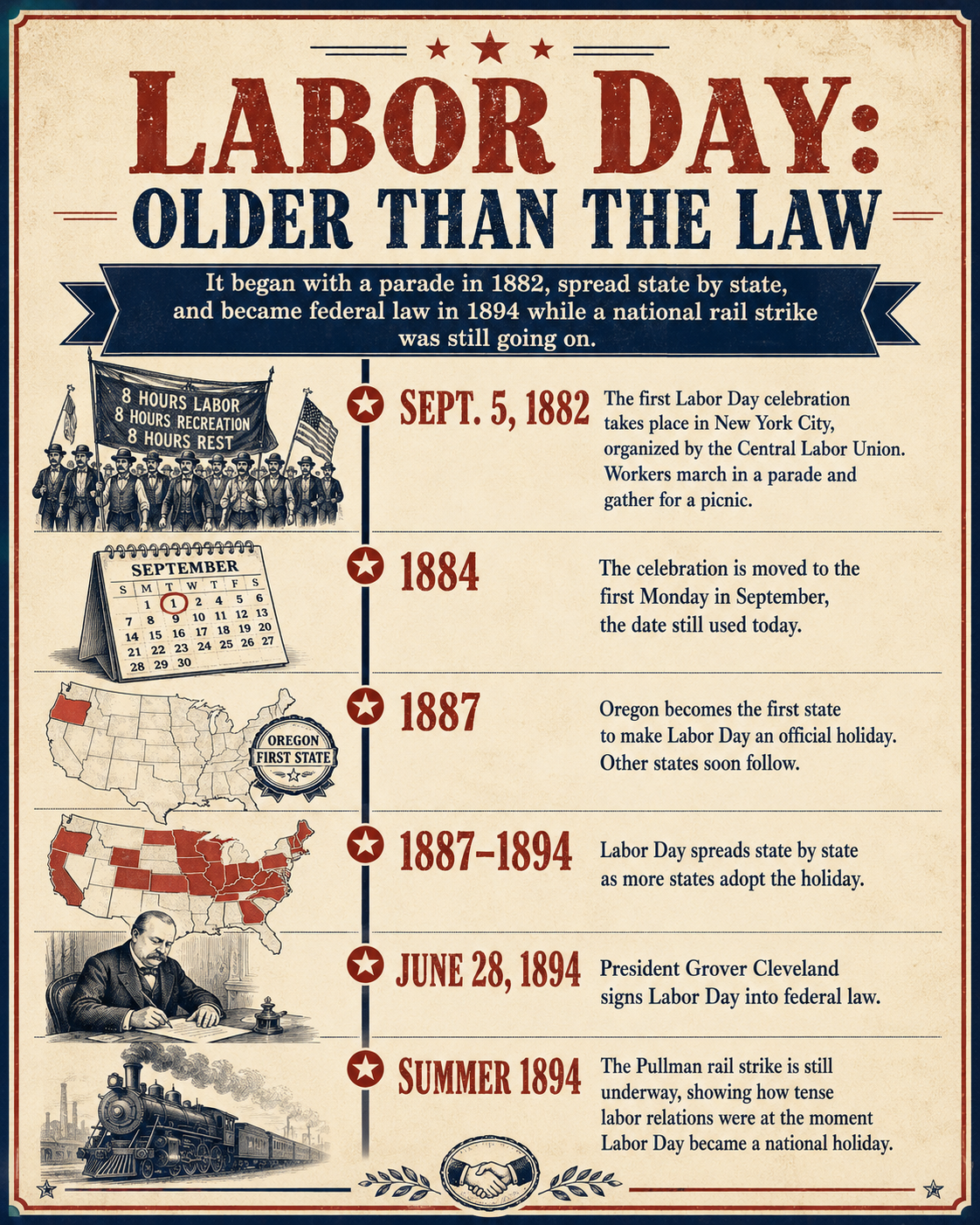
Labor Day is older than the law that created it. It started with a parade in New York in 1882, spread state by state, and became federal law in 1894 while a national rail strike was still going on. A short history, with the dates.
Your insurance card, without the phone call
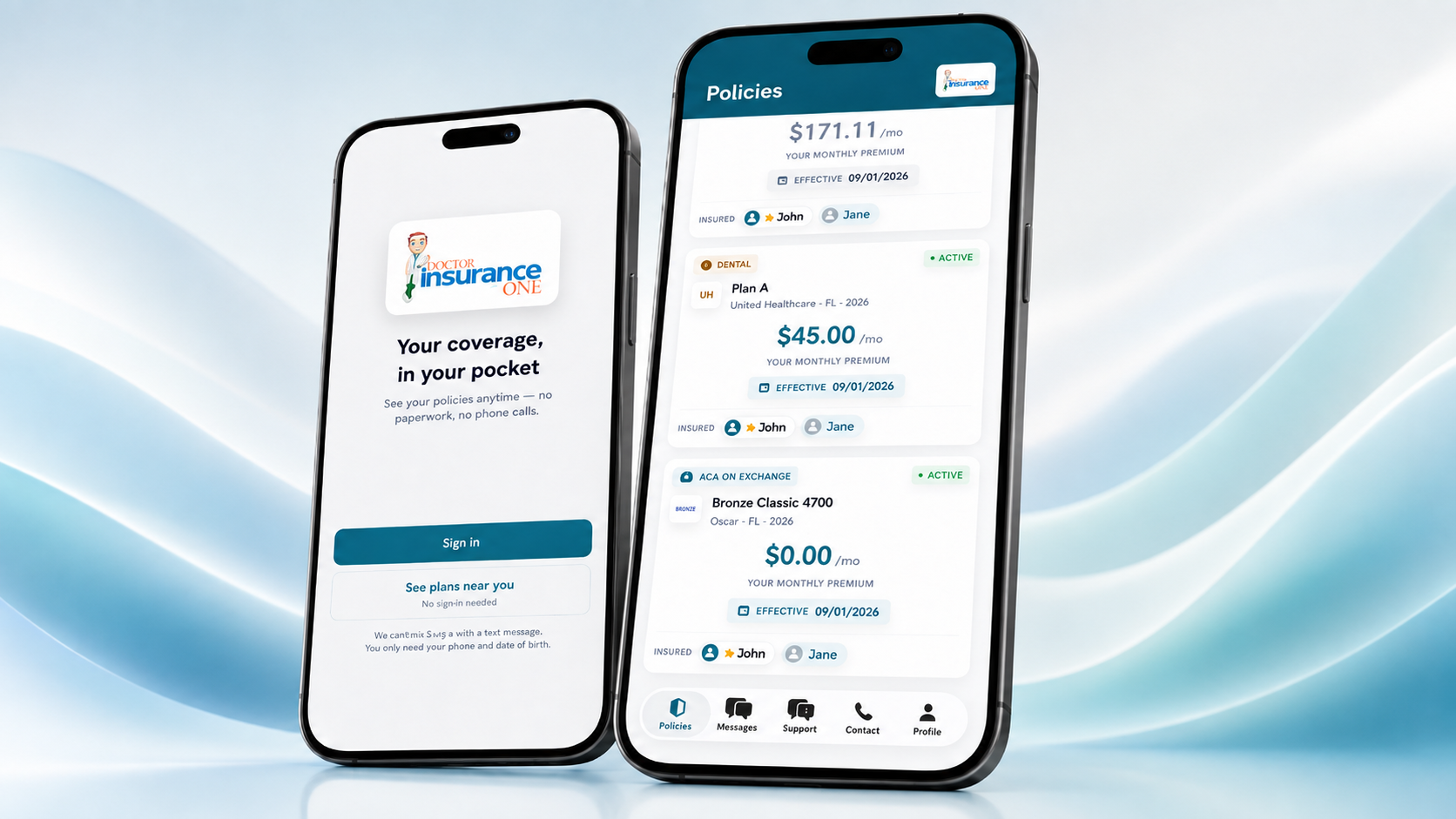
You can now see your policies, find your member ID, ask for your insurance card and message your agent from your phone. It is free, it is in English and Spanish, and getting in takes about two minutes. Here is what it does, and what it does not.