
Why the first Monday in September is a holiday
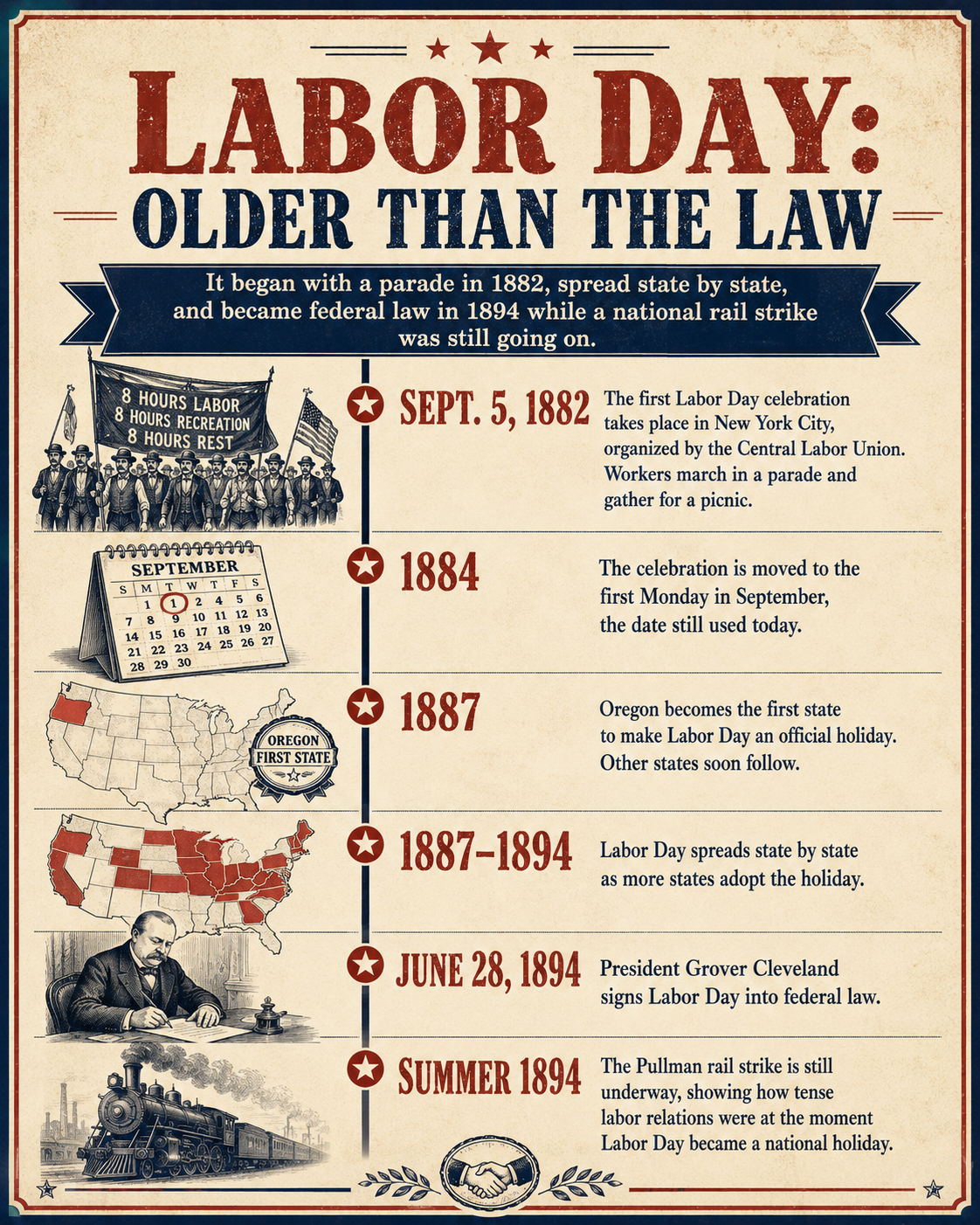
Our office is closed on Monday, September 7, 2026 for Labor Day. It is one of the few American holidays that workers started themselves, years before any government made it official. Here is where it came from, with the dates.
The work the holiday came out of
In the decades after the Civil War, a job in an American factory, mill, railroad or mine commonly meant 12 hours a day, six or seven days a week, in crowded and poorly ventilated buildings with little access to fresh air, sanitation or breaks. Children as young as five or six worked in the same places. The strikes and rallies demanding a shorter day and safer conditions are what produced the holiday.
The first Labor Day: Tuesday, September 5, 1882
The first observance was held on Tuesday, September 5, 1882, in New York City, following the plans of the Central Labor Union. Roughly 10,000 workers took unpaid time off to march from City Hall to Union Square. Bricklayers, jewelers, typographers, and dress and cloak makers walked with their locals, and the day ended in picnics, speeches, fireworks and dancing.
Two details are worth holding onto. It fell on a Tuesday, not a Monday. And there was no law behind it and no paid day off, so every person in that parade gave up a day of wages to be in it.
Who proposed it has never been settled
Two men are credited, and the record has never been resolved between them.
- Peter J. McGuire, general secretary of the Brotherhood of Carpenters and Joiners, who is said to have suggested setting aside a day as a "general holiday for the laboring classes" in 1882.
- Matthew Maguire, a machinist, who was serving as secretary of the Central Labor Union in New York that same year.
The U.S. Department of Labor says more recent research supports Maguire's claim. Britannica treats the question as still open. The near-identical names are part of why it has stayed unsettled for well over a century.
From one parade to the states
In 1884 the Knights of Labor adopted a resolution naming the first Monday in September as Labor Day, and the observance spread. Oregon became the first state to give it legal standing on February 21, 1887, although it initially placed the holiday on the first Saturday in June. Colorado, Massachusetts, New Jersey and New York followed later in 1887, and Connecticut, Nebraska and Pennsylvania before the decade was out. By 1894, another 23 states had adopted it.
So the holiday was already in law across much of the country before Congress ever voted on it.
1894: the federal law, and the year it passed in
The federal bill was S. 730, introduced in the Senate in August 1893. It was still waiting when the Pullman strike began.
Workers at the Pullman Palace Car Company near Chicago walked out on May 11, 1894 over wage cuts. On June 26 the American Railway Union, led by Eugene V. Debs, began a nationwide boycott of Pullman cars that crippled rail traffic. Federal troops were sent in, and more than a dozen workers were killed.
The bill moved during those same days. On June 26, 1894, the chairman of the House Labor Committee, Lawrence McGann of Illinois, took up the Senate bill in the House, and it passed with no objection. President Grover Cleveland signed it on June 28, 1894, making the first Monday in September a legal holiday in the District of Columbia and the territories. The strike was still going on when he signed.
Historians commonly read that timing as a conciliatory gesture toward labor at a moment of open conflict, and Britannica describes it in those terms. That is an interpretation of motive rather than a documented fact, and it is worth keeping separate from the dates, which nobody disputes.
Why September, and not May 1
Most of the world honors workers on May 1. That date traces to the Haymarket affair in Chicago, where demonstrations for an eight-hour day began on May 1, 1886 and a bomb was set off on May 4; the person who threw it was never identified. An international gathering of socialists in Paris later named May 1 a workers' holiday, now International Workers' Day.
September was already the American date and carried none of that association, which is the reason usually given for keeping it. McGuire's own explanation for September was simpler: it fell roughly halfway between the Fourth of July and Thanksgiving, a long stretch of the calendar with no holiday in it.
What the day is for
The Department of Labor's own wording is the plainest available: Labor Day is "an annual celebration of the social and economic achievements of American workers."
What that movement went on to win reads better as a list than as an argument. Henry Ford more than doubled pay to $5 a day in 1914 and cut the workday from nine hours to eight in 1926. The Fair Labor Standards Act of 1938 limited child labor, set a federal minimum wage and required overtime pay. By the 1940s the average workweek was down to five eight-hour days. The 12-hour, six-day week that the 1882 marchers stepped away from for one afternoon is no longer the ordinary American job, and that is the change the holiday marks.
Our office on Monday
We are closed Monday, September 7 and open again Tuesday, September 8 at 10:00 a.m. Leave a voicemail or send a message over the weekend and we will pick it up first thing Tuesday.
Sources
- U.S. Department of Labor, History of Labor Day
- History.com, Labor Day
- Encyclopaedia Britannica, Labor Day
- Smithsonian National Museum of American History, The making of Labor Day
- Investopedia, Labor Day History: Origins, Significance, and Celebration
- U.S. House of Representatives, History, Art and Archives, The first Labor Day
Where these sources disagree, the disagreement is described above rather than settled. Sources consulted September 3, 2026.
Recent posts
Medicare before December 7: what to do, even if you have no plan
Open enrollment runs October 15 to December 7. It is not only for people who already have a plan. The penalty that never goes away, the 20 percent with no ceiling, and the Medigap door that opens once.

A new Marketplace rule: you have to authorize your agent. Here is how.
Starting this fall, the Marketplace requires you to authorize your agent once a year before we can work on your application. We will send you that request through HealthSherpa, by text or email. It is real, it takes a minute, and without it we cannot renew your coverage for 2027.

It Started With a Lizard: How a Diabetes Medicine Became a Weight-Loss Treatment
Ozempic, Wegovy, Mounjaro and Zepbound were made to treat type 2 diabetes. Then patients started losing weight. How a gut hormone, a desert lizard and a determined scientist led to today's weight-loss medicines, what they can do, and whether your insurance will pay.